About
Electrical and Computer Engineering is at the forefront of the newest technology. The discipline has moved beyond wires and circuits into cutting-edge technology. The Department of Electrical & Computer Engineering was established in 2004. Department offers B.Tech. Electrical and Computer Engineering with an intake of 60 plus and M.Tech in Power Electronics and Mtech in Energy system with an intake of 18 each . The department head has a vast industrial and teaching experience and is ably supported by well qualified vibrant faculties and non-teaching staffs.
The academic offering is focused on the theoretical and practical aspects of Electrical Machines, Control Systems, Power Systems, Electrical and Electronic devices & circuits, Instrumentation etc. Electrical & Computer Engineering Department conducts career developing, interpersonal and intrapersonal skills of students. It organizes Seminars, Quiz Programmes, Industrial Visits, Paper Contests, Group Discussions, Guest Lectures, Games etc under its auspices.
The students are encouraged to present papers and to participate in seminars conducted in other engineering colleges. Industrial tours are arranged for students to obtain an exposure to industries.
Programmers offered by the Department
- B.Tech. in Electrical and Computer Engineering
- M.Tech. in Energy Systems
HoD’S MESSAGE
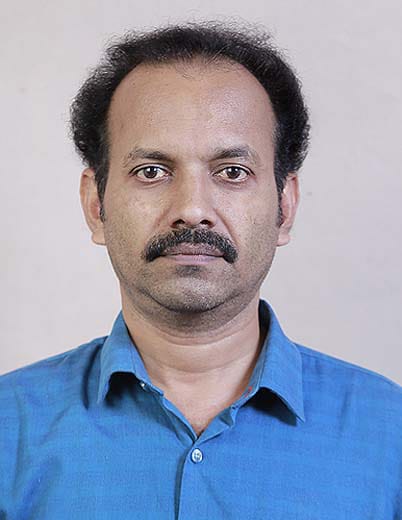
Dr. Johnson Y
Professor and HoD
Postdoc, PhD, M. Tech, B. Tech, DIM, MCP, MIE
welcome you to EEE, NCERC, dedicated to ensuring great careers for our students. We are forging deeper industry linkages, creating an academic and research culture from the starting day and assuring the seamless education using the state of art technology available.
We have invested a great deal of time and energy in creating strong foundations for our department and will continue to do all that it takes to ensure the bright career opportunities through placement-focused studies for our student.
The excellent infrastructure, well experienced teaching faculty of the best kind of the Department ensuring quality education such as interaction among students, parents and staff, along with a Training and Placement Cell ensures a bright future to its students.
I wish to appreciate the team of faculty members and the students for their brilliant and tireless efforts. Depending upon the interest of the student, he/she may choose to go for higher studies or employment and can choose to do research & development, design, production, application, testing, or management in the Electrical and its allied technologies. We give special focus to the link between electrical technologies and the AI & ML related technologies by conducting appropriate workshops, seminars etc so that the student can enter the modern industrial world with more confidence. We strongly encourage innovation in research, in teaching and in service to the profession, the local community and industry. I wish all the students and faculty a good academic career.
Sincerely, and with best wishes,
VISION
To excel in technical education and research in the field of Electrical & Computer Engineering by imparting innovative engineering theories, concepts and practices to improve the production and utilization of power and energy for the betterment of the Nation.
MISSION
- To offer quality education in Electrical and Computer Engineering and prepare the students for professional career and higher studies.
- To create research collaboration with industries for gaining knowledge about real-time problems.
- To prepare students with sound technical knowledge.
- To make students socially responsible.
PROGRAM OBJECTIVES
- Engineering Knowledge: Apply the knowledge of mathematics, science, engineering fundamentals and an engineering specialization for the solution of complex engineering problems.
- Problem Analysis: Identify, formulate, research literature and analyse complex engineering problems reaching substantiated conclusions using first principles of mathematics, natural science and engineering sciences.
- Design and development of solutions: Design solutions for complex engineering problems and design system components or processes that meet the specific needs with appropriate considerations for public health safety and cultural, societal and environmental considerations.
- Conduct investigations of complex problems: Use research based knowledge and research methods including design of experiments, analysis and interpretation of data and synthesis of the information to provide valid conclusions.
- Modern tool usage: create, select and apply appropriate techniques, resources and modern engineering and IT tools including predictions and modelling to complex engineering activities with an understanding of the limitations.
- The Engineer and society: Apply reasoning, informed by the contextual knowledge to assess societal, health, safety, legal and cultural issues and the consequent responsibilities relevant to the professional engineering practices.
- The Engineer and society: Apply reasoning, informed by the contextual knowledge to assess societal, health, safety, legal and cultural issues and the consequent responsibilities relevant to the professional engineering practices.
- Environment and sustainability: Understand the impact of the professional engineering solutions in societal and environmental context and demonstrate the knowledge of and need for sustainable development.
- Ethics: Apply ethical principles and commit to professional ethics and responsibilities and norms of the engineering practice.
- Individual and team work: Function effectively as an individual and as a member or leader in diverse teams and in multi disciplinary settings.
- Communication: Communicate effectively on complex engineering activities with the engineering community and with the society at large such as, being able to comprehend and write effective reports and design documentation, make effective presentations and give and receive clear instructions.
- Project management and finance: Demonstrate knowledge and understanding of the engineering and management principles and apply these to one’s own work, as a member and leader in a team, to manage projects and in multidisciplinary environments.
- Life – long learning: Recognize the need for, and have the preparation and ability to engage in independent and life – long learning in the broadest context of technological change.
PROGRAM SPECFIC OBJECTIVES
- Apply Science, Engineering, Mathematics through differential and Integral Calculus, Complex Variables to solve Electrical Engineering Problems.
- Demonstrate proficiency in the use of software and hardware to be required to practice electrical engineering profession.
- Apply the knowledge of Ethical and Management principles required to work in a team as well as to lead a team.